
Have you started exploring the Indian stock market? Then, you must have come across the discussion about futures and options trading. There are some traders who speak about the excitement that comes with F&O India, while some warn about its dangers. Then, what’s the real story?
Here’s the thing. Futures and options trading can become a powerful financial tool in your hands if you know how to make good use of it. However, getting into it without having any knowledge can prove disastrous.
It is always wise to educate yourself before getting into any investment. At Chanakya Investments., we believe informed investors make better financial decisions. Here is a guide to the concept of F&O India.
What is Futures and Options Trading?
In futures and options trading, the investor buys/sells derivative contracts instead of buying the asset itself.
These contracts get their value from various assets like stocks, indices, commodities, and currencies.
While both futures and options trading belong to the derivatives market, they differ in terms of working.
What Are Futures?
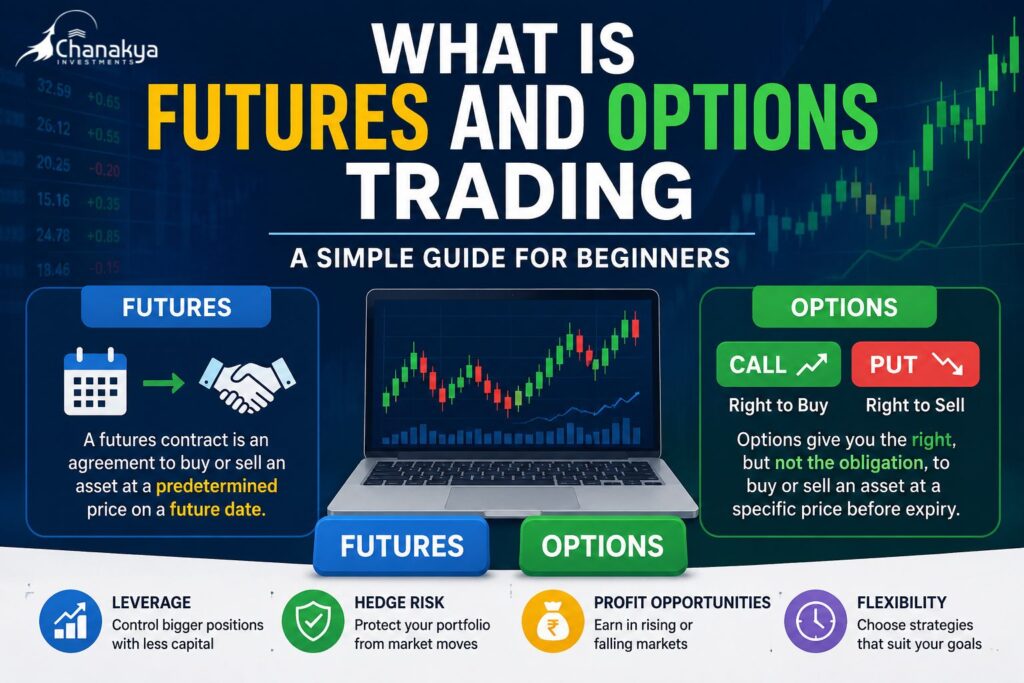
It is a kind of contract where two parties agree to buy or sell an asset at a pre-decided price and date.
For instance, you may think that the price of Reliance Industries is going to go up next month. Then, you can enter into a futures contract to buy them at a pre-decided price in the future.
No matter whether the prices go up or down, the party has to fulfill the terms of the agreement on the expiry date.
What Are Options?
Option trading provides you with the right, but no obligation, to buy or sell an asset at a pre-decided price on or before the expiry date.
Here are two major kinds of options:
- Call Option – Buyer gets the right to buy.
- Put Option – The buyer gets the right to sell.
While it is not the case in futures, options traders are free not to exercise the contract if there is no profitability in it. The loss is limited to the premium paid.
Futures vs Options in Simple Terms
To give an example, consider booking a wedding hall.
A futures contract can be likened to signing a non-refundable agreement, which means you must honor the deal as agreed.
An option is like paying the booking fee, which allows you to decide later about proceeding further. If you change your mind, you lose only the booking fee.
Understanding the Basics of the Futures Market
Before understanding the basics of the futures market, it is better to familiarize oneself with some of the common terms related to it.
Futures Contracts
They include:
- Underlying asset
- Contract price
- Quantity
- Expiry date
Expiry Date
All futures contracts have a pre-defined expiry date. On the NSE, the contracts expire on predetermined dates, which are mostly on a monthly basis.
Lot Size
The F&O contracts are traded in predetermined quantities, which are called the lot size.
For instance, if one contract has a lot size of 50 shares, then you must trade all 50 together and not just one share.
Margin Trading
You do not need to pay the full contract value, but you have to deposit the percentage called margin.
This is why there is leverage in F&O trading, as the traders control larger positions with less capital.
Settlement
The contracts are settled in two ways: cash settlement and delivery. It depends on SEBI regulations and exchange rules.
Example
Let us assume that the futures of Nifty are trading at 26,000. You expect the index to touch 26,400 before expiry. In case your prediction is right, then you may make profits. Otherwise, in case the price falls, then the leverage may result in bigger losses.
Understanding the Options Trading
Options trading becomes easier to understand for many beginners through some examples from daily life experience.
Suppose you pay a small advance for booking a new apartment. It gives you an option to buy the apartment later.
If the price of property rises, then the reservation turns out to be valuable.
But if the price goes down, then you simply walk away, losing just the booking fee.
Options work the same way.
Call Option
The call option makes the buyer gain in case of rise in prices.
For example, if you expect the price of Tata Motors to move up, then buying call option would allow you to gain from the rising prices.
Put Option
The put option allows the buyers to gain in case of fall in prices.
Usually, investors use put options to hedge their portfolio.
Premium
The buyer pays a certain fee called a premium for purchasing an option.
Strike Price
Strike price is the price at which the buyer has the right to buy or sell the underlying asset.
Buyer vs Seller
The risk in the case of the buyer is limited, as the most he/she can lose is the premium paid.
On the other hand, the seller, who is called the writer, earns the premium, but may have much higher risk in case of sharp movements of the market.
Futures vs Options
| Feature | Futures | Options |
| Risk | Can be high | Risk for the buyer is usually limited to the premium |
| Cost | Margin is required | Payment of the premium by the buyer |
| Profit Potential | Unlimited in both directions | Depends on the strategy |
| Obligation | Mandatory settlement | Optional for the buyer |
| Flexibility | Low | flexibility |
| Best Suited For | Experienced and hedgers | Beginners who learn with caution and experienced traders |
| Capital Required | Generally high due to margins | Less for option buyers |
Why do Traders Opt for F&O in India?
There are many reasons why investors engage in F&O India.
Hedging
The traders use F&O to mitigate their risks.
For instance, a person who has shares may choose a put option in case of a market crash.
Speculation
Some traders attempt to earn profits from short-term changes in the prices without owning the underlying asset.
Portfolio Protection
Options may reduce losses in times of market uncertainty.
Leverage
Since the margin or premium is enough, traders can enter the bigger positions than in the cash market.
However, the leverage will increase both profit and loss at the same time.
Short-term Trading
Many traders use NSE futures and Bank Nifty options since they provide the opportunity according to the short-term market changes.
Benefits of Futures and Options Trading
Responsible use of F&O gives many advantages.
- The ability to hedge investment risks.
- Access to leverage and efficient capital use.
- The opportunity to earn in rising and falling markets.
- Good tool for diversifying the portfolio.
- High liquidity in popular contracts.
- Appropriate for experienced traders with good risk management.
These advantages should always be considered together with the risks.
The Risks Every Beginner Should Be Aware Of
F&O is not a shortcut to easy profits.
Here are some examples of risks.
High Leverage
The leverage may multiply the return, but it will also multiply the losses.
Market Volatility
The prices may change rapidly owing to the news, economy, or other world events.
Time Decay
The options lose their value when the expiry date comes, especially in the case when the expected movement doesn’t occur.
Margin Call
In the futures, an additional deposit may be required due to the change in the position against the investor’s interests.
Emotional Trading
Fear and greed often cause bad decisions.
Lack of Knowledge
Many beginners lose money just because of the trade without understanding the basics.
At Chanakya Investments, education is the priority. Learning how F&O works is much more valuable than earning fast profits.
How Beginners Can Start F&O Trading in India?
Starting in the right way may help to avoid many mistakes.
- Open the Demat and trading accounts with the registered broker.
- Learn about futures market fundamentals before you start trading.
- Learn risk management and position size.
- Use the paper trading or the virtual platforms.
- Start trading with small positions.
- Use the stop losses in all trades.
- Analyze every trade and learn.
If you want to understand the Indian stock market, Chanakya Investments can help you with educational courses to be prepared for F&O trading. The emphasis is put on informed decisions.
Mistakes Many Beginners Make
First-time traders commit many mistakes.
- Trading without understanding the product.
- Using excessive leverage.
- Not using the stop losses.
- Following the tips from social media blindly.
- Overtrading after a couple of successful trades.
- Not understanding the option premiums.
- Betting more money than you can afford to lose.
Avoiding these mistakes will help to improve your learning process and to preserve your capital.
Is Futures and Options Trading for You?
Not every person needs F&O.
Ask yourself the following questions:
- Do I understand the fundamentals of the derivatives market?
- Am I comfortable with the increased risk?
- Am I able to handle the loss emotionally?
- Do I have the trading plan?
- Am I going to invest the money I can afford to lose?
If you answered “no” to several questions, it is necessary to learn more before you start trading.
For many people, long-term equity investing may be more appropriate than active F&O trading.
Conclusion
Futures and options trading is an important part of the Indian financial market, which gives many opportunities to hedge the risk, speculate, and manage the portfolio. However, it is also very risky for beginners.
Understanding concepts like futures contracts, option contracts, margin trading, expiry date, call options, put options, and risk management may help to make better decisions.
Instead of making your first trade as soon as possible, it is better to gain the knowledge and develop a responsible approach. Chanakya Investments recommends investors to learn first, understand the risks, and make decisions according to their financial goals. If you want to understand the stock market in India and invest with more confidence, contacting Chanakya Investments is a good idea.
Frequently Asked Questions
1. What is futures and options trading?
Futures and options trading include buying and selling derivative contracts whose value depends on assets like stocks or indices. In futures, both parties are obliged to complete the deal. In options, the buyer gets a right, but he is not obliged to complete the contract.
2. Is the F&O trading safe for beginners?
It may be risky for beginners because of the leverage and market volatility. Before investing, it is necessary to understand the basics.
3. What is the difference between futures and options?
Futures require completing the contract from both sides. In options, the buyer has a choice to exercise the contract or not.
4. Can beginners trade options?
Yes, but first, it is necessary to understand such concepts as premiums, strike price, and risk management.
5. How much money is needed to start the F&O trading?
The amount depends on the contract, lot size, and the broker’s requirements. Option buyers usually need less money than the futures traders.
6. Is F&O better than equity investing?
No. Equity investing is more appropriate for creating wealth in the long-term. F&O is used mainly for hedging and short-term trading.
7. What is a margin in F&O trading?
The margin is the amount that is deposited to open and maintain the specific F&O position. It allows using the leverage but also increases the risks.
8. Is F&O trading legal in India?
Yes. F&O India is regulated by SEBI and conducted on the recognized exchanges like NSE under the established rules.