
What is Beta in Stock Market?
If you invest in the stock market, you may have heard the term Beta (β). But what does Beta mean, and why is it important for investors?
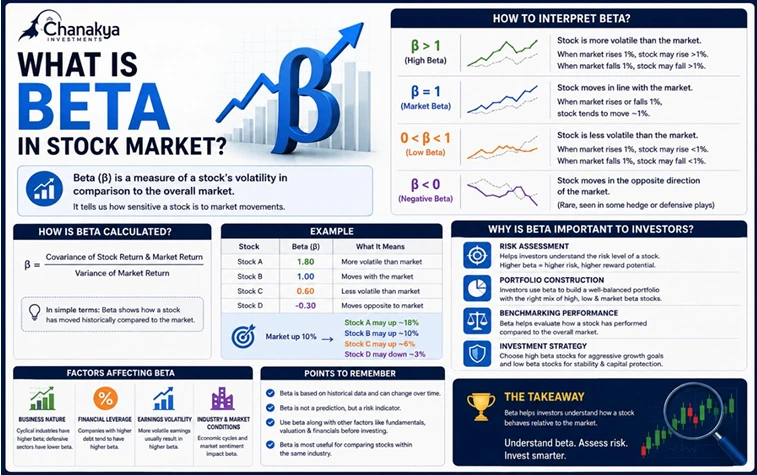
Beta in the stock market measures how much a stock’s price moves compared to the overall market. It helps investors understand the volatility and risk level of a stock.
In India, Beta is generally measured against the Nifty 50 index. It represents systematic risk, which is the market risk that cannot be completely removed through diversification.
In simple terms, Beta tells investors:
“If the market moves by 10%, how much is this stock expected to move?”
Beta Formula in Stock Market
β = Covariance (Stock Returns, Market Returns) ÷ Variance (Market Returns)
Where:
- Covariance shows how stock returns move compared to market returns.
- Variance measures market return fluctuations.
Analysts also use the Blume-Adjusted Beta to adjust Beta values closer to 1 over time.
Adjusted Beta Formula:
Adjusted β = (0.67 × Raw β) + (0.33 × 1)
How to Interpret Beta Values?
| Beta Value | Meaning | Stock Type |
|---|---|---|
| β > 1 | More volatile than the market | Technology, small-cap, growth stocks |
| β = 1 | Moves with the market | Market-linked stocks |
| 0 < β < 1 | Less volatile than the market | FMCG, pharma, utilities |
| β < 0 | Moves opposite to the market | Inverse assets and hedging instruments |
Real Example: Asian Paints Beta
Asian Paints has a Blume-Adjusted Beta of approximately 0.27 based on historical monthly observations compared with the Nifty 50.
This means:
- If the Nifty 50 rises by 10%, Asian Paints may move around 2.7%.
- The stock generally shows lower volatility compared to the broader market.
A lower Beta makes such stocks suitable for investors looking for relatively stable investment options.
Why Does Beta Matter for Investors?
1. Risk Assessment
Beta helps investors identify whether a stock is aggressive or defensive.
- High Beta stocks may provide higher return potential but involve greater price fluctuations.
- Low Beta stocks may offer better stability during uncertain market conditions.
2. Portfolio Management
Investors can combine high and low Beta stocks to create a balanced portfolio.
- High Beta stocks support growth strategies.
- Low Beta stocks help reduce overall portfolio volatility.
3. CAPM and Expected Returns
Beta is an important part of the Capital Asset Pricing Model (CAPM), which estimates expected returns.
Expected Return = Risk-Free Rate + β × Market Premium
A higher Beta generally indicates higher expected returns because investors take additional risk.
4. F&O Hedging
Traders use Beta to calculate hedge requirements for equity portfolios. It helps estimate the futures contracts needed to reduce market risk exposure.
5. Sector Analysis
| Sector | Beta Trend |
|---|---|
| IT | Higher Beta |
| Metals | Higher Beta |
| Small-Cap Stocks | Higher Beta |
| FMCG | Lower Beta |
| Pharma | Lower Beta |
| Utilities | Lower Beta |
Limitations of Beta
Although Beta is a useful risk measurement tool, it has some limitations:
- Beta is based on historical data and may not always predict future movements.
- It does not consider company-specific factors like management quality, financial strength, or business growth.
- Beta can change as market conditions and company performance change.
Investors should use Beta along with other factors such as:
- P/E Ratio
- ROE
- Debt Levels
- Revenue Growth
- Profitability
Beta should not be the only factor considered while investing.
Conclusion
Beta in the stock market helps investors understand risk, volatility, and market behavior. While it is a useful tool for portfolio planning, investors should combine it with fundamental analysis before making investment decisions.
At Chanakya Investments, we provide market insights, investment strategies, and research-driven updates to help investors make smarter financial decisions.