
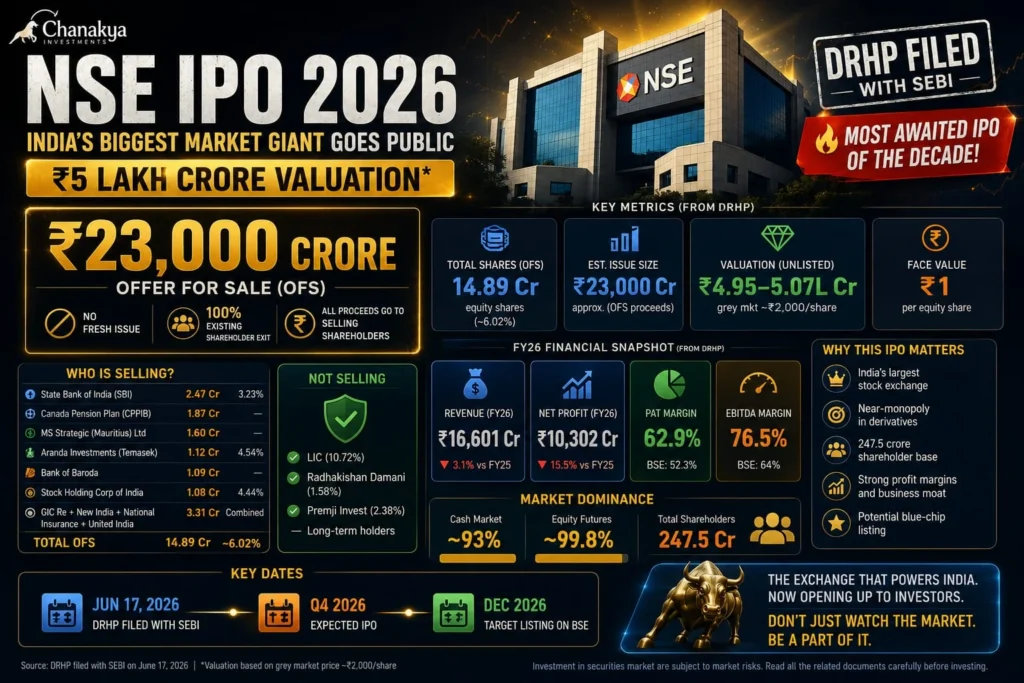
The Indian capital markets are preparing for one of the biggest and most anticipated public offerings in recent history. On June 17, 2026, the National Stock Exchange (NSE) officially filed its Draft Red Herring Prospectus (DRHP) with SEBI, setting the stage for a landmark IPO expected before the end of the year.
For investors, traders, and market enthusiasts, this is more than just another IPO. It represents an opportunity to own a stake in the institution that powers the majority of India’s stock
market activity. As India’s largest stock exchange moves closer to becoming publicly listed, understanding the business, financials, opportunities, and risks becomes essential.
The Journey to Listing
NSE’s IPO journey has been anything but straightforward.
The exchange initially attempted to go public in 2016. However, the process was halted following the co-location controversy, where certain market participants were alleged to have received unfair access to NSE’s trading infrastructure. The matter led to years of regulatory investigations, legal proceedings, and governance reforms.
A major breakthrough came in 2025 when NSE submitted a settlement application worth ₹1,387.39 crore to resolve regulatory issues related to the co-location and dark fibre cases. Following this development, SEBI granted a No Objection Certificate (NOC) in January 2026, paving the way for the exchange’s listing plans.
The filing of the DRHP marks the official beginning of NSE’s long-awaited entry into the public markets.
IPO Structure: A Pure Offer for Sale
One of the most important aspects investors should understand is that the NSE IPO is structured entirely as an Offer for Sale (OFS).
Unlike many IPOs where companies raise fresh capital for expansion or debt reduction, NSE will not receive any proceeds from this issue. Existing shareholders are simply selling a portion of their holdings to the public.
Key highlights include:
- Total OFS: 14.89 crore equity shares
- Approximately 6.02% of total equity
- Face value: ₹1 per share
- Estimated issue size: Around ₹23,000 crore
- No fresh issue component
This means the IPO is primarily aimed at providing liquidity to existing investors while allowing retail and institutional investors to participate in NSE’s future growth story.
Who Is Selling Their Stake?
Several prominent institutions are participating in the OFS.
Major selling shareholders include:
- State Bank of India (SBI)
- Canada Pension Plan Investment Board (CPPIB)
- Temasek-backed Aranda Investments
- Bank of Baroda
- Stock Holding Corporation of India
- GIC Re
- New India Assurance
- National Insurance Company
- United India Insurance Company
Interestingly, some of NSE’s most notable shareholders are choosing not to sell.
These include:
- LIC (10.72% stake)
- Radhakishan Damani
- Premji Invest
The decision by these long-term investors to retain their holdings is being viewed by many market observers as a sign of confidence in NSE’s long-term value and growth potential.
Financial Performance: Strong Profits Despite Regulatory Headwinds
The financial data disclosed in the DRHP presents a mixed picture.
For FY26, NSE reported:
- Revenue: ₹16,601 crore
- Net Profit: ₹10,302 crore
- PAT Margin: 62.9%
- EBITDA Margin: 76.5%
Although revenue declined by 3.1% and net profit fell by 15.5% compared to FY25, NSE remains one of the most profitable exchange businesses globally.
The primary reason for the earnings decline was SEBI’s regulatory tightening in the derivatives segment. Changes such as increased lot sizes, restrictions on weekly expiries, and upfront premium collection reduced trading activity in Futures & Options (F&O), which remains NSE’s biggest revenue contributor.
Despite these challenges, NSE’s profitability remains significantly higher than many global exchanges and even its domestic peer, BSE.
NSE’s Unmatched Market Leadership
Perhaps the strongest investment case for NSE lies in its dominant market position.
The exchange continues to command extraordinary market share across key segments:
- Around 93% market share in cash equity turnover
- Approximately 99.8% market share in equity futures
- Nearly 74.7% market share in equity options
- World’s largest exchange by number of equity derivative contracts traded
NSE is also the owner of the iconic Nifty 50 index and licenses more than 425 indices across various market segments.
This level of dominance creates a powerful competitive moat that is difficult for rivals to challenge.
Additionally, NSE maintains a treasury and investment portfolio worth nearly ₹3 lakh crore, generating substantial investment income that helps stabilize overall earnings.
Valuation Debate: NSE vs BSE
Once listed, NSE will create India’s first direct comparison between two publicly traded stock exchanges.
Current unlisted market estimates suggest an implied valuation of approximately ₹4.95 lakh crore to ₹5.07 lakh crore. Based on prevailing unlisted market prices, NSE is believed to be trading at roughly 35-40 times FY26 earnings.
In comparison, BSE currently trades at a higher valuation multiple due to its faster earnings growth and expanding options market presence.
This sets up an interesting debate for investors:
- NSE offers scale, profitability, and market dominance.
- BSE offers faster growth and expanding market share opportunities.
The market will ultimately determine which business deserves a premium valuation.
What Happens Next?
With the DRHP now filed, the next steps include:
- SEBI review and observations.
- Roadshows and investor meetings.
- Announcement of the IPO price band.
- Subscription period, expected around October–November 2026.
- Listing on BSE.
Since regulations do not permit an exchange to list on itself, NSE shares will be listed on BSE.
Final Thoughts
The NSE IPO is not merely another public offering-it is a milestone event for India’s financial markets. For the first time, retail investors will have the opportunity to own a stake in the institution that serves as the backbone of the country’s equity and derivatives ecosystem.
While investors should carefully evaluate valuation, regulatory risks, and future growth
prospects, there is no denying that NSE represents one of India’s most strategically important
financial institutions.
As the IPO process unfolds, understanding the business model, market dominance, and financial dynamics of NSE will be crucial for making informed investment decisions.
🚀 Follow Chanakya Investments for regular stock market updates and insights.